
The Leadership Skill No One Teaches: Letting People Struggle
Mar 31, 2026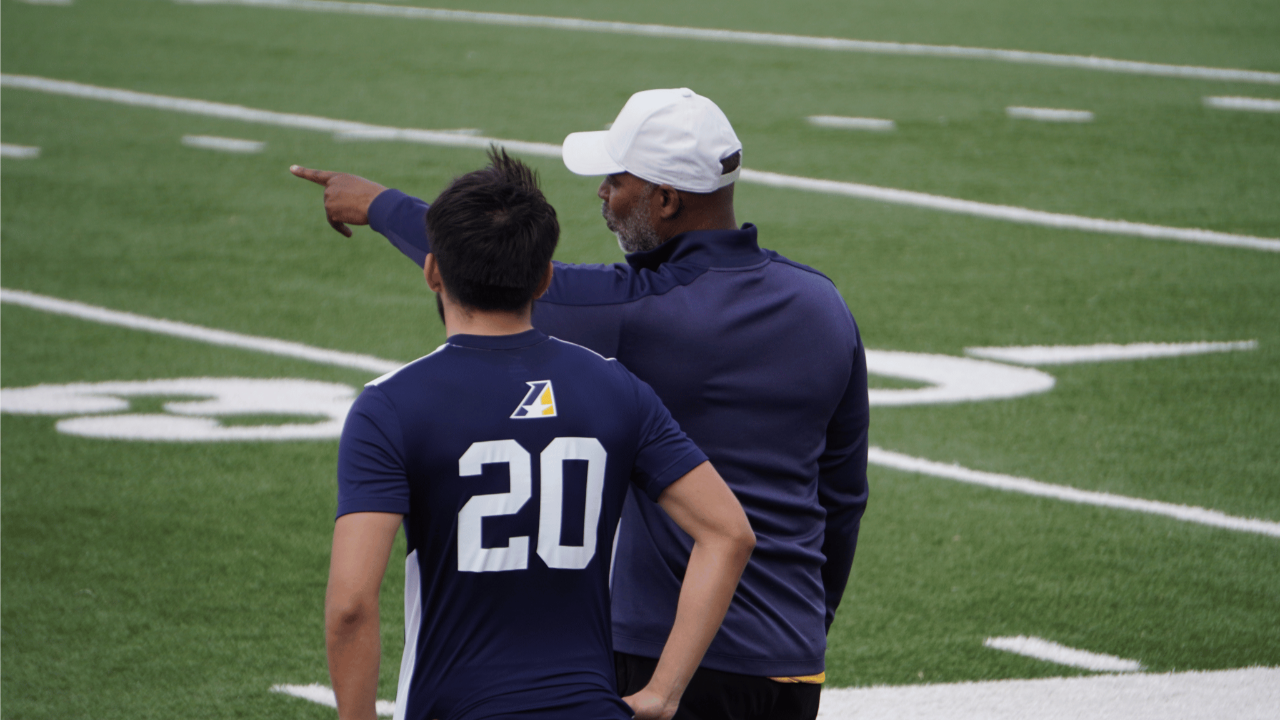
The goal of leadership is not to be needed.
It’s to build people who don’t need you, and that requires one of the hardest skills of all: Standing on the sidelines, watching the struggle and choosing not to step in—yet. Because in that moment, growth lives.
I was coaching in a spring college soccer game this past weekend, and I realized I had forgotten this important principle. We were down 2-0 in the first 30 mins. One of my players—talented, hardworking, full of potential—kept making mistakes (wrong decision, wrong space, wrong timing). I began to notice myself disrupting his flow to fix it in real time which was distracting him from the task at hand. I shouted instructions. I corrected him. I coached every movement, every decision and every touch. For a brief moment, it worked. He adjusted. He looked better. The mistake disappeared, but something else disappeared, too--his confidence, his instinct and his ownership of the game. By the second half, he wasn’t playing anymore. He was waiting; waiting for me to tell him what to do next, and that’s when it hit me. I wasn’t developing him. I was making him dependent on me. This is what I call ‘Coaching by Joystick,’ and have tried to avoid in myself and in coaches I’ve mentored over the years. Simply said, “You can’t play the game for them.”
We don’t talk enough about this in leadership because stepping in feels like leadership. It looks like leadership. It gets rewarded like leadership. In sport, it sounds like constant instruction from the sideline. In business, it shows up as rewriting emails, hijacking presentations and rushing to solve conflicts. We call it ‘support;’ but often, it’s something else. It’s control--micromanagement dressed up as care. Underneath that control is a quiet discomfort—not with their performance, but with their struggle. Watching someone struggle—especially when you know you can help—is one of the hardest things to do as a leader.
I want to remind you, as I needed to remind myself this past weekend, struggle is not a sign that something is wrong. It’s a sign that something is working. It means they are stretching beyond what is comfortable. It means they are making decisions without a safety net. It means they are in the exact place where growth happens, and when we, as leaders, step in too early, we interrupt that process. We trade long-term development for short-term relief.
We get the immediate result, but we lose the future leader.
There is a quiet discipline required here . . . a willingness to hold tension instead of resolving it. Leadership is not about removing every obstacle from someone’s path. It’s about helping people to learn how to navigate obstacles without you.
So how do you know when to step in or when to step back?
It’s not a formula. It’s a judgment call shaped by awareness. Here’s how I approach this conundrum:
- If the consequence of the mistake is temporary, the lesson is meaningful, and the person has the capacity to figure it out, step back. Let them wrestle with it. Let them feel it. Let them own it.
- If the cost is too high, the mistake will create lasting damage, or they are no longer learning, step in. Try not to take over, but to guide. Try not to rescue, but to recalibrate.
My experience as a professor helped me find a solution to this common leadership problem. Using the Socratic method, I replaced instruction with curiosity. Instead of saying, “Do this.” I started asking, “What are you seeing?” or “Why is this going sideways?” Then, I waited. At first, the silence felt long, uncomfortable, and (my least favorite) inefficient, but in that silence, something important happened. Just like in class, they started thinking. They started connecting. They started leading themselves.
We live in a world that moves fast. A world full of deadlines and pressure. In that environment, stepping in can feel like the responsible choice. Let me remind you, leadership is not just about getting things done. Leadership is about growing people who can get things done without you, and that requires restraint. It requires trust. It requires us to sit on our ‘mama bear/papa bear’ instincts and watch someone struggle . . . believing they will find their way through.
One day, they won’t have you on the sideline. They won’t have you in the meeting. They won’t have you there to step in. The question will no longer be, “Did you help them succeed?” It will be, “Did you prepare them to succeed without you?”
That’s the real test of leadership.
Author

