
How to Drive Behavior Change
Feb 17, 2026
The other day I was in a gym at a university where I was consulting. It was a beautiful facility — brand-new equipment, clean floors, the kind of space that makes you want to train hard and take pride in where you are. Mid-workout, a sign on the wall caught my attention.
It read:
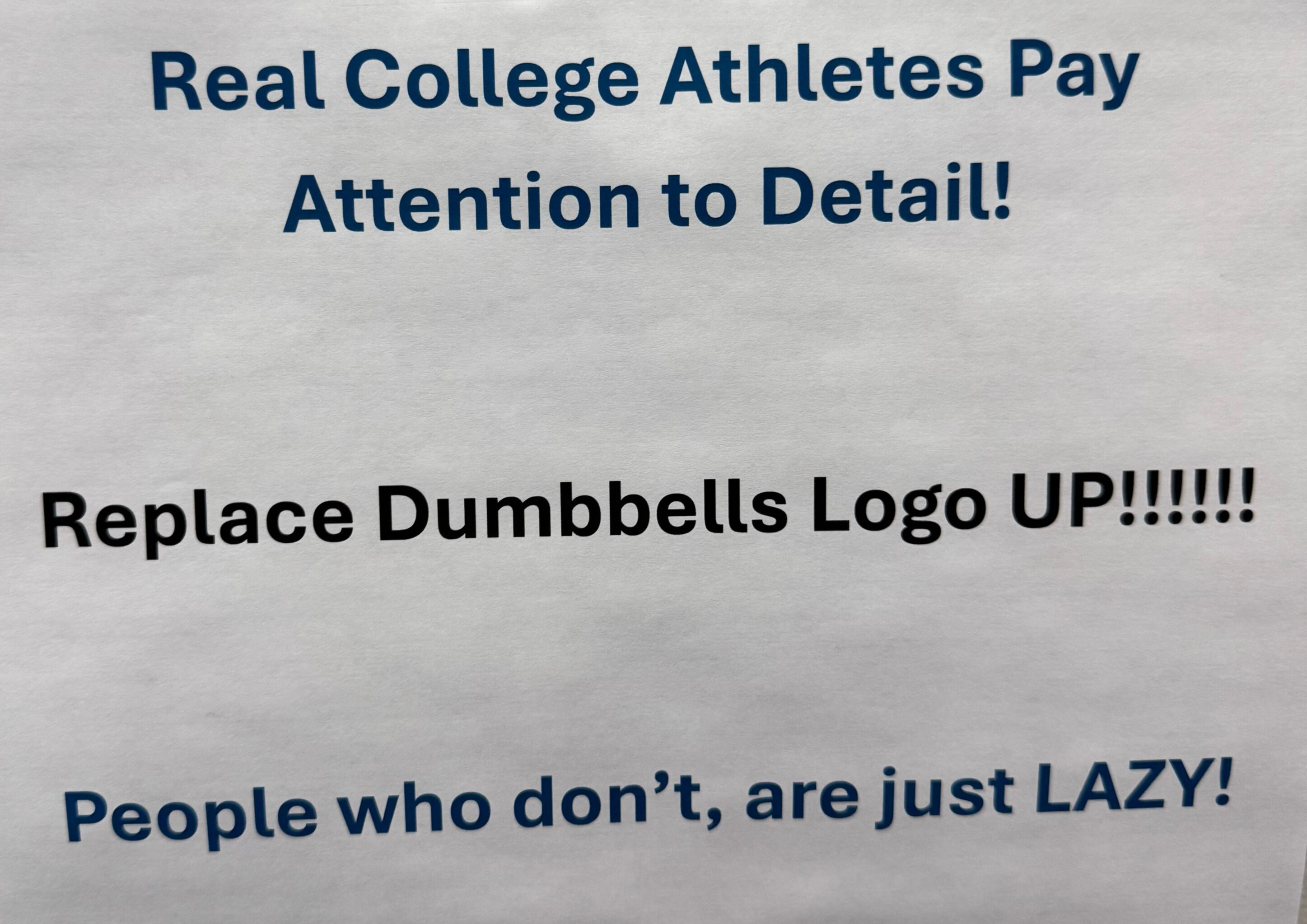
You could almost hear the frustration in the punctuation, and I understood it.
The author cared about the space, wanted standards. They wanted athletes to take responsibility and pride in their environment, but what happened next holds the real lesson.
I overheard two athletes nearby who read the sign.
One said, “Why is this guy yelling at us?”
Another laughed and said, “I’m putting the dumbbells upside down just to mess with him.”
That moment captures one of the most important truths about leadership:
You don’t create excellence by shaming people into compliance. You create excellence by reinforcing the behaviors you want repeated.
Or, as sport psychologist Dr. Colleen Hacker famously says: “Catch them when they’re good.”
The Leadership Mistake We Sometimes Make
Most leaders don’t intend to be negative. They simply get tired. They repeat instructions. They correct mistakes. They see the same small issues over and over again. Eventually, frustration replaces strategy.
The sign in the gym wasn’t about dumbbells. It was about a leader trying to enforce standards without understanding how behavior actually changes. Many people find themselves promoted into management without specific leadership training. For too long, our society has diminished the importance of training people leadership, executive communication and workload management calling them ‘soft skills.’
This is common in leadership, coaching, parenting and management.
In the void of that formal training, we tend to believe:
- Correction drives improvement.
- Criticism builds discipline.
- Pressure creates accountability.
Research consistently shows something different.
The Science of Positive Reinforcement
Psychologist B.F. Skinner’s behavioral research demonstrated decades ago that positive reinforcement is one of the most powerful drivers of sustained behavior change. When desired behaviors are rewarded or acknowledged, they are far more likely to be repeated.
Dr. Martin Seligman reinforced this idea. Seligman’s research proves that environments emphasizing strengths, recognition and optimism lead to:
- Higher motivation
- Greater persistence
- Improved performance
- Increased well-being
This applies to classrooms, companies and locker rooms.
In fact, Gallup research on workplace engagement found that employees who receive regular recognition are significantly more engaged and productive than those who primarily receive corrective feedback.
Correction changes behavior incrementally. Recognition changes behavior exponentially.
Standards Without Positivity Become Resistance
Let’s be clear: standards matter. Details matter. Accountability matters.
How leaders communicate expectations determines whether people internalize them or resist them.
The gym sign communicated standards through criticism, and criticism often triggers three predictable responses:
- Compliance without commitment
- Quiet resentment
- Passive resistance
You saw all three in those athletes’ reactions. When people feel judged, they don’t lean in — they pull back. This is where leadership maturity matters because great leaders understand something subtle but powerful:
You can demand excellence without diminishing people.
Psychological Safety and Performance
Harvard professor Amy Edmondson’s research on psychological safety shows that teams perform best when individuals feel respected, valued and safe to contribute without fear of embarrassment or ridicule. Psychological safety doesn’t mean lowering standards.
It means creating environments where people want to meet them. One of the fastest ways to build psychological safety is simple: Notice what people are doing right. I mean, not occasionally, not when performance reviews come around--consistently.
Rewriting the Sign
After my workout, I spoke with the leader responsible for the gym--not to criticize — but to offer a different approach. I suggested replacing the sign with something that communicated the same expectation but in a way that invited cooperation rather than resistance.
The new message read:
“Thank you for placing the dumbbells back logo up 🙂
Details lead to excellence.”
Same expectation. Different leadership strategy. One assumes laziness. The other assumes pride. One pushes people away. The other invites them in. Leadership often comes down to these micro decisions.
The Difference Between Fixing Mistakes and Building Culture
Most leaders spend the majority of their time correcting errors. That’s understandable. Problems are visible and urgent, but culture isn’t built by fixing mistakes.
Culture is built by reinforcing the behaviors you want repeated.
In high performance this must be intentional.
The best leaders don’t only correct misses, they actively reinforce:
- effort
- communication
- discipline
- attention to detail
- teamwork
Why? Behavior grows where attention goes.
When leaders focus only on mistakes, teams become mistake-avoidant.
When leaders reinforce positive behaviors, teams become excellence-seeking.
Here is why that sign really mattered…
Leadership Has Emotional Contagion
Every leader sets an emotional tone. Frustration spreads. Cynicism spreads.
Respect also spreads. Gratitude also spreads.
When leaders lead with irritation, teams mirror it.
When leaders lead with belief, teams mirror that too.
That gym sign didn’t just communicate expectations — it communicated emotion. People respond more to emotion than instruction. That’s why leadership is less about control and more about influence.
Here’s a simple challenge you can try this week:
Instead of correcting the next mistake you see, pause and look for someone doing it right.
Then say something . . .out loud . . . in the moment . . . specifically.
You’ll be surprised how quickly desired behavior spreads.
Excellence is contagious when leaders notice it.
That day in the gym reminded me of something simple and powerful:
People don’t rise to criticism — they rise to belief.
So, the next time you’re tempted to ‘write the lazy sign,’ ask yourself:
How can I catch them when they’re good?
Author

